Journal
A year ago Friday May 14, 2010, 0 comments
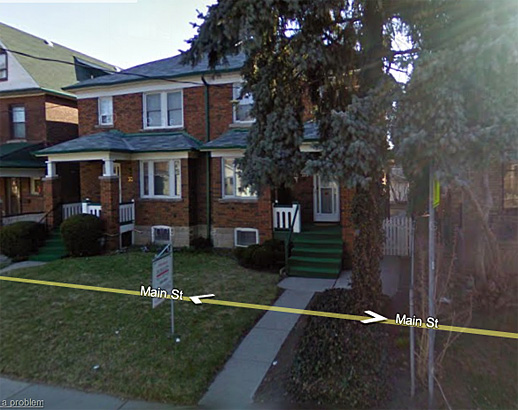
A year ago we bought our house. It doesn’t feel like a year has passed, and looking at the images from Google Street View versus a photograph of the house from the street today, it doesn’t look like much has changed.
Google Street View:
From outside today:
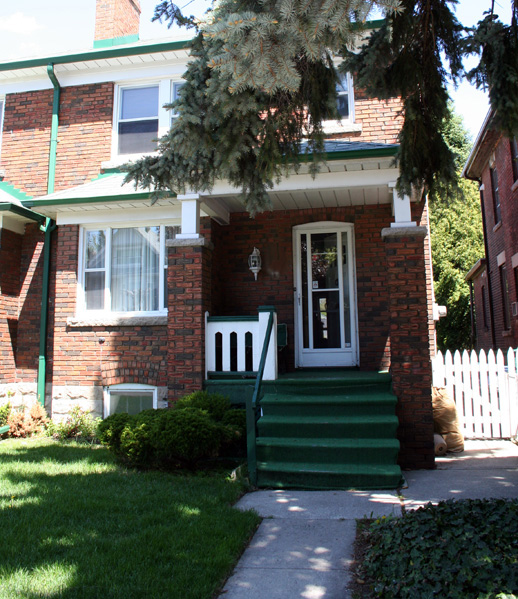
But the house has changed a lot. The entire kitchen has been replaced. The ‘finished’ basement has been mostly ‘unfinished’ – meaning we took out all the scary open-cell insulation that was holding moisture, chucked the nasty faux wood panelling that graced so many basement renos from the 1970s and removed the most ghetto shower you can even imagine. Sarah’s done tons of gardening, and about 90% of the electrical system has been completely replaced.
Roses Tuesday May 4, 2010, 0 comments
As I mentioned recently, Sarah and I used to live on a boat. We would get up every morning after an amazing sleep (all that fresh air) and sit in the cockpit while the sun rose. We’d sip our tea. It was calm and quiet. We’d eat breakfast to the calls of cormorants and enjoy a moment of sunshine and peace before starting our days. In the evenings, after work, I’d come home and we’d cook dinner while out ghosting on the lake. We’d come back in when the sun went down.
For sure there were downsides. We had a 200 foot walk to the toilets and showers, because we didn’t use the head on our boat and it didn’t have a shower anyway. We didn’t have a lot of room for stuff. It got incredibly hot in the summer sometimes, and Sarah (working from home) had to seek refuge in air conditioned coffee shops and the supermarket frozen food section.
A few years later and we live in a nice three-bedroom house in the city that we own. We have lots of stuff (too much stuff!) in our house. We have a nice garden and an amazing kitchen and a wonderful life, but we both remember that summer of living on the boat with extreme fondness. Neither of us really remember the downsides, only the good parts. The peace. The quiet. The simplicity of our lives.
I think that sort of peace is much harder to achieve when one’s lifestyle is ‘normal’. Maybe all the material possessions throw out some sort of dampening field that blocks clarity of mind.
Lately I’ve been feeling a lot of internal pressure to own more ‘stuff’, a feeling that it will somehow make me happier. It is an incredibly insidious feeling. I want things, except I don’t really think I do want them, I just believe I do. I might be a reaction to job stress, life stress, the general stresses of home ownership or the general stresses of living. It is not helped by the fact that I cannot avoid the news and media as much as I’d like to, since I actually work for one of Canada’s largest media companies.
But I remember that one summer on the boat, that one summer of simplicity, and I think that maybe I need a bit more of that in my life. I want to cycle to and from work in a leisurely manner, not worry about how short I can make my commute. I want to enjoy some of the sunshine and the amazing Toronto summer. Time to simplify, perhaps. I have some ideas.
I don’t much care for stopping to smell the roses, but I want to have the time to if I so choose.
Too big Monday April 26, 2010, 0 comments
If you have, through your hard work and perseverance, managed to amass so much material stuff that it prevents you from dropping everything you are doing and going on a great adventure, your life has become too big to fail.
And just like with banks, that’s a bad thing.
You’ve all thought it before. That you’d love to drop everything and cycle across North America, or backpack across Europe, or downhill ski in every timezone, or sail around the world, or whatever. Maybe it’s as tame as that ubiquitous fantasy – starting your own business. We’ve all thought about how great that would be. How rewarding. And then what happens?
You start thinking about what it would mean to actually do it. You’d have to give up your job. And that would really hurt your career, right? And then there’s the mortgage. How would you pay that? And you just bought a shiny new A3 that has another 59 payments. They’re not going to happen by themselves, are they.
If you have so much stuff that it stops you from being able to live every day of your life, then you have too much stuff. Time to pare down, and get rid of some stuff.
How important is your career, really? More important than living a meaningful life? How much would your career be hurt if you actually took a year off?
Is your house so important it cannot be replaced? What about that car? Your computer? iPhone? Bike? Is any of it important?
Don’t be too big to fail. Own your stuff. Don’t let it own you.
Ubiquitous Wednesday April 14, 2010, 0 comments
They’ve been saying it for years: the future of the web is mobile. I think it’s finally true, but even more, I think the web has become ubiquitous.
Desktop computers for consumers are largely finished, if you ask me. There are exceptions: If you’re a gamer, then you want a pretty serious desktop computer. Places like libraries will always have desktop computers because laptops are simply too expensive for them, and desktops are less likely to get stolen. You’ll find desktop computers in companies that do a lot of video editing, or 3D modelling, or anything else that requires large screens and a lot of horsepower.
If fact anything that is focused on creating content is probably well suited to a desktop computer. For the sake of completion I will say that a laptop will do in a lot of these situations, such as web design and development, but largely, I think the distinction is sound. Desktop workstations are ideally suited for content creation.
But most people don’t create content, other than blog posts and uploading pictures of their cats, dogs, houses, cars, kids, families and vacations. Most people consume content, and content consumption is far more suited to mobile devices like netbooks, laptops, smartphones (iPhones, really), iPod Touches and iPads. These devices – especially iPhones, in my opinion – fit into our lifestyles in a way that computers never have in the past.
Make no mistake. It may be called an iPhone, but it is a computer, and a very very good one. It fits in my pocket, has ubiquitous connection to the cloud, and a vast array of native and web apps available for the platform. The barrier to entry for usage is incredibly low – it’s second nature to whip out my phone to check facts, check mail, contact someone, whatever. The fact that it also makes telephone calls and replaces my iPod is pure icing. I bought it so I could have a computer with me at all times. It has let computing and the web penetrate my life like never before, and that’s impressive, considering I’ve been in the web development field for a decade and a half.
I know it’s no longer cool to gush over iPhones now that the iPad is out, but damn it, my iPhone fits in my pocket. The iPad is awesome, but the iPhone goes everywhere with me. Both are changing the way people interact with data, the way they communicate with each other, and the way they think about computing. It’s a paradigm shift that’s sweeping old and tired methods of working with computers out the door. It is abstracting people from the computer while at the same time making interaction with their data far more intimate.
This is a very good thing. People can pick up and put down the web as easily as they used to pick up and put down a book. They no longer need to sit down at a computer to ‘get online’. They’re already online. The web is ubiquitous.
The browser on the desktop as we’ve known it will remain important, but the browser in our phones (and iPods and iPads and all the the mobile computing devices) are finally the future that the web has been promising us.
Go West, part 6 Monday April 5, 2010, 0 comments
They started moving into the house the next day. The big yellow truck was parked across the street, and the boy’s father had pulled out the long extension ramp from underneath. Slowly, a box at a time, the load in the truck was shifted into the house.
And it was an actual house. Mostly an actual house. The boy had spent all his time in the city, had grown up in a three-story apartment block overlooking the Humber Valley, and then later on the twelfth floor of a tall, imposing condominium tower in Etobicoke that overlooked the Airport. He had never lived so close to the ground before. But this was a house. Well, a row-house (a ‘townhouse’, his father called it. He wondered if that meant that houses in the city were called ‘city houses’) anyway. It was at the end of a long row of mostly identical houses, with white siding walls and green roofs.
Because of the weight of most of the possessions being transferred into the house, the boy was not able to help very much. He had carried in the few things he could manage, and was then excused from any more heavy lifting and told to explore the housing complex.
First he walked around it, counting the houses. He counted 25, and then the road curved around the last house in the row. Here the road was shaded by tall evergreen trees – taller than any trees he had ever seen in his life. He pondered the shadowy road for a moment, then spotted something that surprised him. Curiosity took over and he started into the shade, only to find a second row of houses identical to the first, but facing the opposite way. And between the two rows of houses, a large common field of green grass and trees.
And more importantly, other children. Children running around, possibly playing tag. He watched for some time, before stepping onto the grass and making his way toward them. He counted four kids, altogether, two boys and two girls. One of each appeared to be his own age, while the others looked to be a couple years younger.
They didn’t see him approach – they were too intently wrapped up in their game, – and didn’t see him even when he’d stopped by the wooden swing set. He didn’t understand why he was suddenly so shy, why he didn’t go up and introduce himself, but it felt right, so he simply stood and watched.
The two boys had long hair – much longer than his (which was sensibly cropped close to his skull). It went over the collar of their t-shirts. He suspected his mother would have called them hoodlums or something. God knows she would never have let him have hair that long. His sister’s hair was barely longer. Otherwise they were dressed mostly the same as him. Aside from the t-shirts (one green with “John Deere” written on it and a picture of a leaping deer, the other white with a yellow smiley-face on it), they were wearing jeans that looked very much like his and shoes like his. Exactly like his, in the case of the boy his own age. He wasn’t sure why, but this made him feel much better.
He had been concentrating so hard on the boys that he had totally forgotten about the girls. So when the younger one tapped him on the shoulder, he jumped about a mile out of his skin and let out an awkward bleating sound. This made the girl giggle.
She was about two years younger than him, dressed in a rainbow coloured t-shirt and short shorts. She had long brown hair tied back in two braided pigtails and bare feet. When she smiled at him he saw she was missing her front teeth.
‘I’m Andrea,’ she said, ‘you’re the new kid who lives in #10, right?’
The two boys had stopped running around and approached them. They introduced themselves as David (the elder) and Mark (the younger). They were brothers and lived down the road.
The boy introduced himself to them too, and started telling them about having moved from Toronto. He had totally forgotten about the other girl until she tapped him on the shoulder and said “Hey, I’m Rachel” to him.
He turned around to introduce himself, and found himself lost in the deep blue pools of her eyes.
Older posts