Journal
Outside the box Tuesday August 19, 2008, 5 comments
Tyler Colman, contributing to the New York Times, tells us why wine should not be bottled, but instead boxed:
A standard wine bottle holds 750 milliliters of wine and generates about 5.2 pounds of carbon-dioxide emissions when it travels from a vineyard in California to a store in New York. A 3-liter box generates about half the emissions per 750 milliliters. Switching to wine in a box for the 97 percent of wines that are made to be consumed within a year would reduce greenhouse gas emissions by about two million tons, or the equivalent of retiring 400,000 cars.
That sounds amazing. Look at all those savings. Not only that:
What’s more, boxed wine is superior to glass bottle storage in resolving that age-old problem of not being able to finish a bottle in one sitting. Once open, a box preserves wine for about four weeks compared with only a day or two for a bottle. Boxed wine may be short on charm, but it is long on practicality.
While I disagree with the idea that one has half-drunk bottles of wine sitting around for more than a day, there’s something to the idea that a Tetra-Pack of wine keeps longer than a bottle.
One concern comes from the recycling angle. How recyclable are tetra-paks? What are the cradle to grave implications (or, for those in the know, the cradle to cradle implications) of plastic-and-paper Tetra-Paks vs. glass – one of the most recyclable materials known to man.
Another concern is from a hazardous materials point of view. What are the bisphenol levels of Tetra-Pak containers? Higher or lower than the traditional glass? Obviously not lower, as glass contains absolutely no bisphenols. Glass is, in fact, completely non-toxic.
While I am reserving judgement on the box vs bottle debate until I have more information, Mr. Colman’s article does demonstrate the biggest problem I have with most “green” movements out there, namely that they are as short sighted as the companies that are creating the problem in the first place. Just because something is ecologically “cheaper” now doesn’t mean it is more environmentally friendly over the long haul.
We need to start looking at cradle to grave costs of the packaging materials we use, in addition to the environmental impact of creating that packaging. We need to look at the impact of these packaging materials on the food chain, and on people.
That's dope Wednesday August 13, 2008, 2 comments
You know, when I hear about athletes doing really well, I feel good for them.
Michael Phelps is now the winningest athlete in Olympic history. He’s got more medals than Carl Lewis now. And more than Paavo Nurmi. And Larysa Latynina, and Mark Spitz.
It’s pretty damned impressive.
Even more impressive when you find out that every single gold medal he’s won so far in Beijing has been as a result of setting a world record – one of them by almost 5 seconds, another by more than two.
That’s even more impressive.
Of course, I wouldn’t be Canadian if I didn’t dispute at least one of Lewis’ medals, but that’s only tangentially related to what I am actually talking about, and that’s doping.
I’m not accusing Phelps of being doped. Well, okay, yes, I am. But I am doing it with absolutely no evidence other than a healthy suspicion of anyone who is outperforming his peers by such an incredible margin.
No doubt they’ve been testing him regularly. The Chinese, among others, would love nothing more than to see all those medals stripped, I’m sure. But I think he’s on something else, something new. Something that’s not being tested for yet.
Don’t get me wrong. I have no doubt the man can swim like a dolphin. Hell, I suspect he could do 200 meters before I got kicked off the wall. I’m not saying he’s not naturally talented, or even that he’s not the greatest swimmer who ever lived.
But I’m more inclined to believe he’s the most successfully doped Olympian in history.
At almost 4am on Sunday morning, I was woken up by what I first thought was incredibly close thunder. It startled me from a deep sleep, and I spent several minutes in a state of disorientation. Then it dawned on me that thunder doesn’t come in a series of individual bangs that sounded suspiciously like someone driving up and down the road firing a very large gun. Bang. Bang. Bang. Then the sirens from the police and fire trucks started. Terrorists? Fireworks? WTF? Turns out a Propane plant exploded about 8km (5 miles) from our house. Scary fireballs in the night sky, a sure sign the end is nigh.
We also got notice from our landlords that we’ll have to find a new place to live come the end of October. At least they gave us some notice. That plus relatively local 30-story-high conflagration straight from the pits of Hell itself equals writing on the wall, as far as I’m concerned.
Signs don’t need to be local. They don’t even need to be national. Not only are the Americans knee deep in both Iraq and Afghanistan, we’re apparently inches from the green light being given to invade Iran? I suspect the American people have reached some sort of saturation on war news, and it doesn’t even register with them any more.
Hell, more Americans die in traffic accidents every year than have ever been killed by terrorists, but you don’t see them rushing to sign away their civil liberties in order to insure that no bottle of Wild Turkey will be responsible for death on the highways. That’s the kind of apathy only Americans and house cats can register. The four horsemen are on their way, and nobody’s even going to put the kettle on.
Then there’s Russia and Georgia, who are still fighting over (and in) South Ossetia. Georgia has been strongly supported by the west, raising the spectre of the cold war all over again. While I think the West – and specifically the American’s – have unwisely written Russia off as a threat only in history, the whole thing smacks of the proxy battles fought in Korea and Vietnam during the Cold War. Chalk up another sign.
We wanted to go to the Taste of the Danforth on Saturday, but the weather was crap. We went anyway, and got torrentially rained on. On the upside, we had some pretty amazing Mexican food afterward (sort of ironic, given the Greek nature of the festival), and got to watch the incredibly bad(!) Starship Troopers 3. Surely that’s got to be another two signs of the Apocalypse?
Now we just need Canada to win a few Gold medals at the Olympics. Then I’d really worry.
Money Thursday July 31, 2008, 2 comments
Some of you may know that I am something of an amateur money collector. Not in the investment sense, in the banknote sense. I enjoy banknotes, the more unusual the better.
I have recently become reacquainted with some of my possessions – many of which I haven’t seen since this divorce process began about two years ago. Among these possessions, stuffed haphazardly in a book were some very interesting banknotes from Germany.
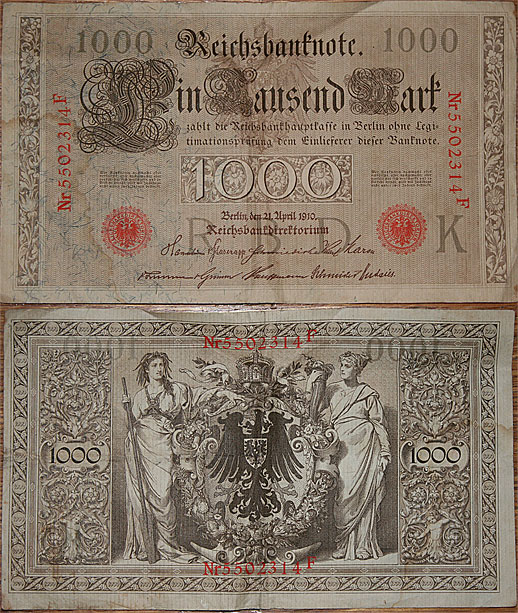
I have two 1000 Reichsbanknotes, one from 21 April, 1910:
The other from 15 September, 1922:
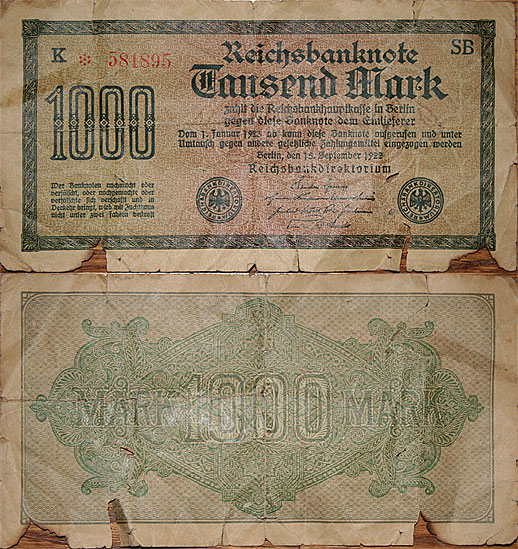
The bills are fascinating, demonstrating that the trend toward Blackletter typefaces and militaristic eagles predate both the Nazis and World War II.
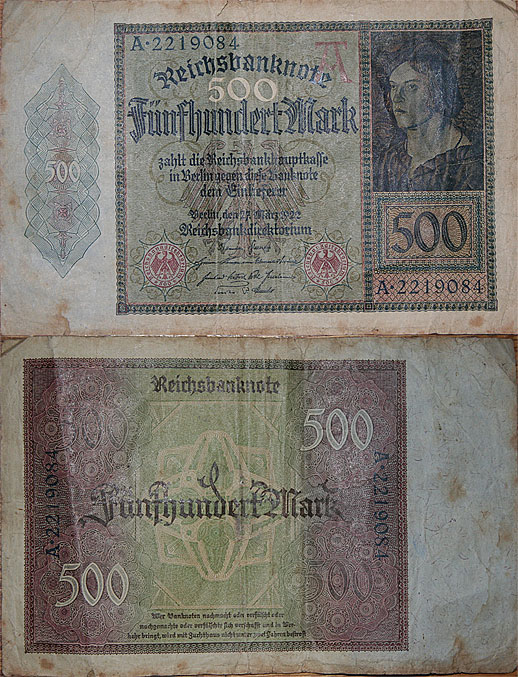
I also have a 500 Reichsbanknote from 27 March 1922:
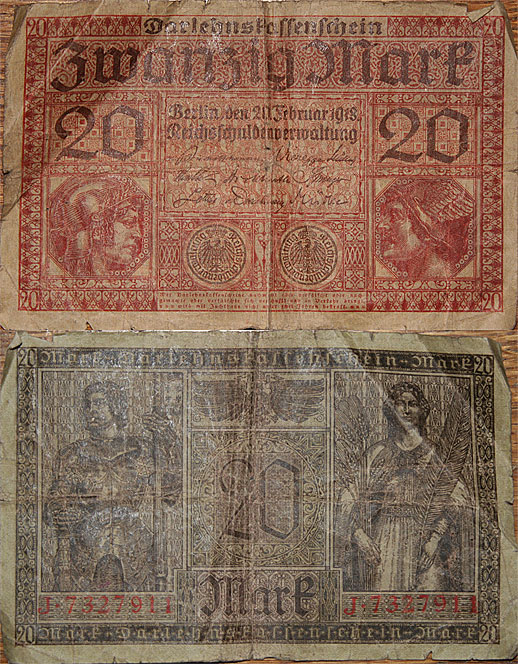
And a 20 Reichsbanknote from 20 February 1918:
While these bank notes do not represent my entire collection, they do represent the oldest of the notes in my possession. I have some older Canadian bills, including a $20 note with the King on it, and Canadian $1, $2 and $5 dollar notes of various designs and vintage.
And I haven’t even got my entire coin collection back yet…
The Kibble Palace Wednesday July 16, 2008, 4 comments
More pictures from our trip to the United Kingdom. The gallery is coming, I promise, but in the meantime I’ll keep posting some of the thousands of photos I took while across the pond.
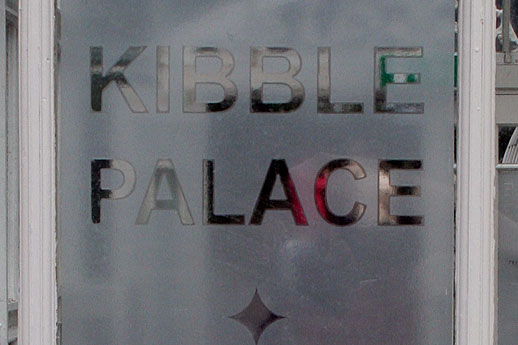
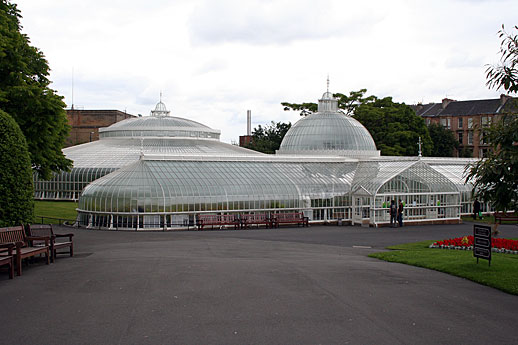
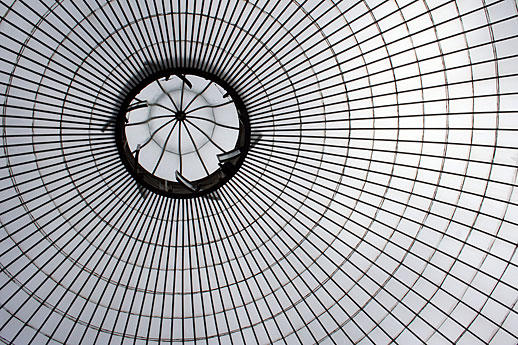
The Kibble palace is located in Glasgow’s Botanic Gardens. It was originally built at the house of engineer John Kibble in the 1860’s, then dismantled, shipped up the River Clyde by barge, and reassembled (and enlarged by increasing the diameter of the main section) in 1873. It was originally intended to be a concert hall and exhibition venue for important events, but was turned over to its current role as a greenhouse in 1881.
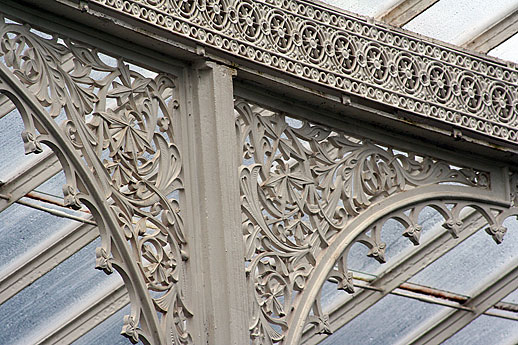
It is built of wrought iron and glass supported by beams of cast iron. Much of the iron-work is incredibly detailed and beautiful.
These pictures do the building no justice. It is an enormous greenhouse, and the glass dome is awe-inspiring. The whole structure is beautiful from every angle.
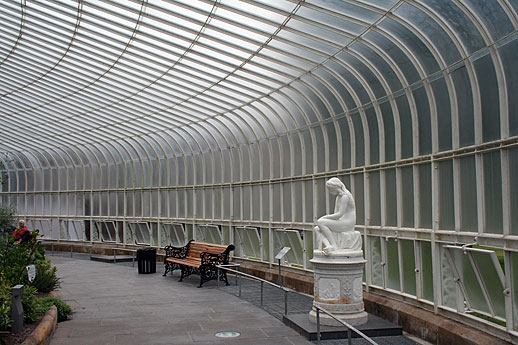
It’s unfortunate that Canadian governments doesn’t seem interested in supporting the development or maintenance of buildings such as The Kibble Palace.
Older posts