Journal
Pathfinder Tuesday June 22, 2010, 0 comments
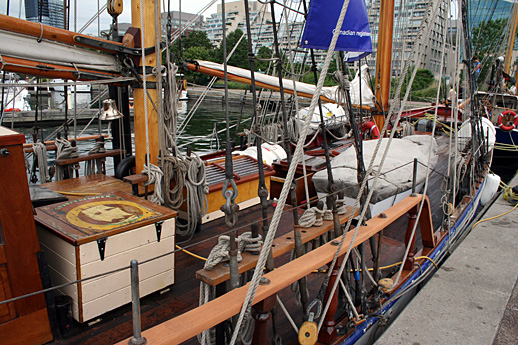
S.T.V. Pathfinder is one of the tall ships I used to sail on as a teenager. My oldest son Jacob, now 15, sailed on her last summer, and after a long hard winter of work, has been promoted to Petty Officer and will be sailing on her (or her sister ship, T.S. Playfair) for much of this summer. My younger son, 13, will be spending eight days on one of the two ships as well.
If you have children in the 13-18 range, I highly recommend the program for character building. Many more pictures of the Brigs at http://www.torontobrigantine.org/
Toronto Harbour, June 20, 2010
Wildlife Sunday June 13, 2010, 1 comments
Algonquin Park is a pretty amazing place. We went up there with Sarah’s parents for three days while they were visiting from Glasgow. Rarely does one get a chance to see so much wildlife as when one is in Algonquin Park.
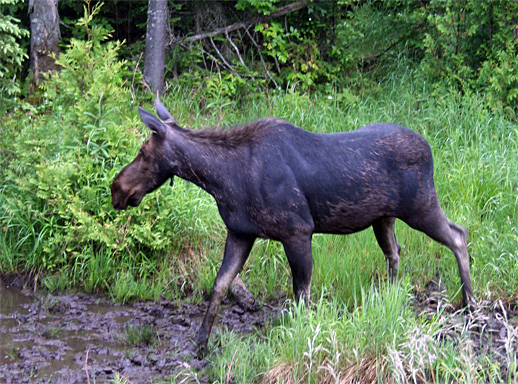
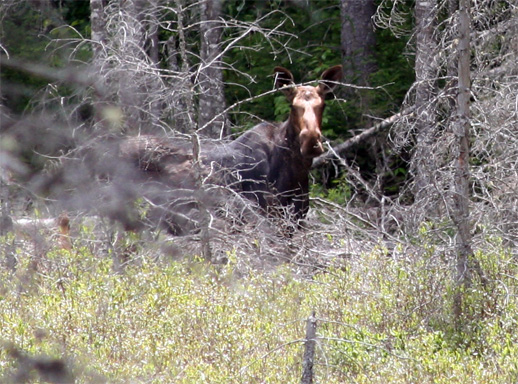
On the first day, Sarah saw a moose on Highway 60 in the park.
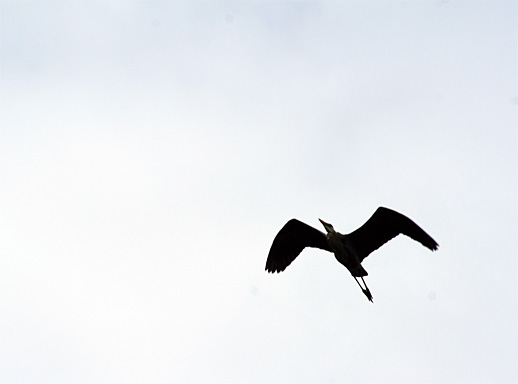
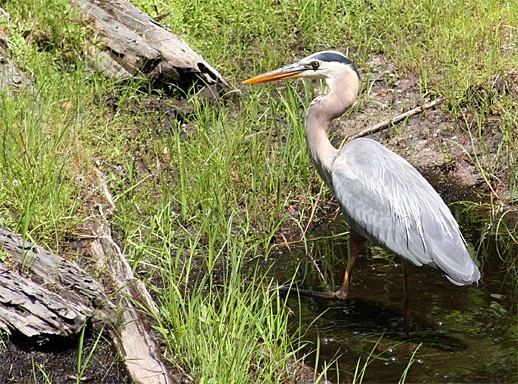
The next day, while canoeing on Oxtongue Lake, I managed to photograph this great blue heron as it flew overhead.
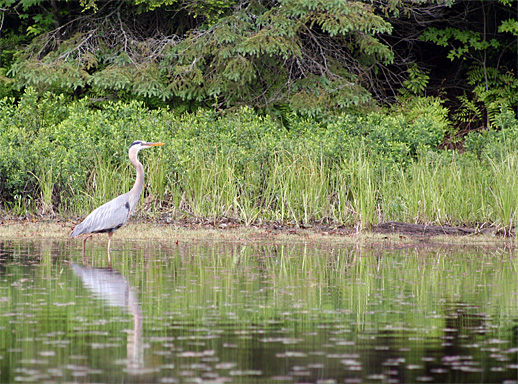
Later he landed and Sarah got me close enough to snap him wading in the shallow marshes that line the shore.
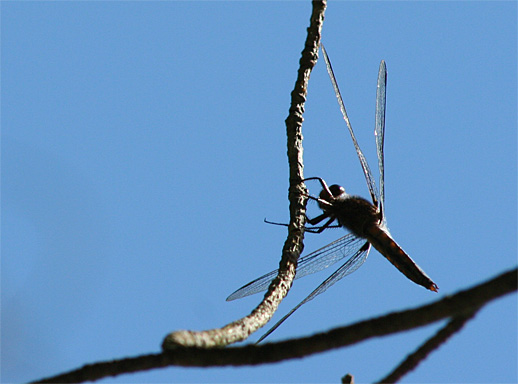
On our third day, we went for a hike on the Mizzy Lake trail, an 11km trail through some pretty dense bush. At Mizzy Lake, I saw this huge dragonfly.
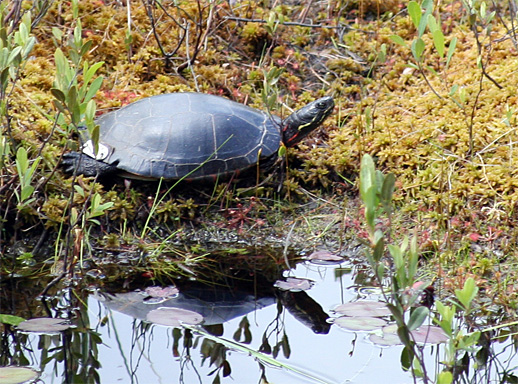
At Wolf Howl Pond, we saw dozens of snapping turtles, many with large white tracking numbers painted on their shells. This one had a metal tag on his shell.
We were walking through the bush when it suddenly opened up onto a little pond, in which this heron was poking around for an afternoon snack. I only had seconds to shoot him before he strutted off into the forest and out of sight.
Within 2km of the end of the trail, we started lamenting that we hadn’t seen any more moose, when we spotted this one up at the end of Dizzy Lake. I actually managed to get a lot closer to it, but it got startled and crashed off into the forest before I could get a shot off.
When the weather is nice, I try to cycle to work as much as I can, and have been doing a pretty good job of it for the last three years we’ve been living in the city. Not as good as I’d like, but not too badly.
One of the great things about cycling to work (and walking, when the weather isn’t conducive enough for me to pedal) is that I get some time to think. And because bikes have been in the news so much lately, and lets face it, also because I’m on a bike, I have been giving a lot of thought to the problems of cycling in the city.
Cars are big, bikes are small, and when they both try to occupy the same space at the same time, the bike is pretty much guaranteed to lose out. This is not a problem that any amount of debate or legislation is going to fix. I know drivers and cyclists will both support me when I say that the only way to solve this is to ensure that cars and bikes never try to occupy the same space at the same time.
Those who don’t cycle will tell you the solution is easy – get the bikes off the roads. Let them ride on the sidewalk, or dedicated bike roadways. Anywhere where the cars aren’t.
Those that do cycle will probably have a different take on the matter, though I know that most of the support the creation of more bike lanes and bikeways. Sure, in an ideal – and somewhat surreal – world, we’d get rid of the cars, but that is simply not going to happen any time soon.
Legislation and debate CAN have an effect on this part of the equation. Cities can create more cycling lanes. Such lanes, when designed well, go a long way to ensuring that the cars and bikes don’t try to occupy the same space at the same time, simply by ensuring that bikes NEVER occupy the same space as cars. And this is a good start. A very good start.
But it’s still addressing the problem laterally. The problem isn’t that cars and bikes are in close proximity, it is that they so often try to be in the same spot.
Many motorists do not feel bicycles belong on the road. Regardless of their personal feelings on the matter, our highway laws do not distinguish between automobiles, motorcycles or bicycles. They are all governed by the same laws. Bicycles are vehicles. End of debate.
Or not, evidenced by so many motorists who continue to honk their horns at cyclists who are not behaving as they think cyclists should. OR when a motorist, outraged that a cyclist is slowing him or her down that they recklessly pass by inches from them, regardless of the fact that they are actually directly and purposely endangering someone’s life.
And there are cyclists do nothing to help. They run through red lights, ride on sidewalks, weave in between traffic and ride the wrong way down one-way streets, and in general, behave recklessly. This infuriates motorists, and I don’t blame them for being upset. It’s dangerous behaviour and it has no place on the streets.
So what’s the solution? As with so many of the world’s ills, the solution may be education. How do we educate cyclists about the rules of the road? How do we educate motorists about bicycles and their position in the transportation ecosystem? I have an idea.
I suggest that no motorist in Ontario be permitted to drive an automobile unless they’ve gone through a graduated license process that includes bicycle training.
What I am proposing is this:
Instead of turning 16 and going down to the MTO to take the test and receive a G1 (learner’s permit) as is the case today, I propose that at age 14, one goes down to the MTO and takes a test of road signs in order to receive a B1 (bicycling license).
Children under the age of 14, I encourage to ride on the sidewalk, but at age 14, any child on a bicycle should be required to have a license to cycle and also be required to operate their bicycle on the road or on designated bicycle ways. It can be restricted in the same way as a G1 license. No alcohol, no riding at night, and so on. Helmets are covered by other laws, but the use of a helmet could be another one of those restrictions.
From two years, the licensed cyclist will obey all the rules of the road. At 16 (or more specifically two years after receiving their B1 license), riders can elect to undergo a practical test demonstrating their knowledge and cycling skills. Success with this test will provide them with a Driver’s License Class B, which entitles them to full cycle privileges on the road, without the restrictions in place on the B1 license, and also grants them a standard Class G1 license, with which they can now learn to operate a motor vehicle.
Any ticket received for failure to follow the rules of the road extends the two year period. The cyclist must have a clean cycling record for 24 consecutive months in order to be eligible to take the ClassB/G1 test.
Adding cycling into the drivers license program ensures that all motorists innately understand the dangers and pitfalls (and joys) of operating a bicycle as a vehicle, since they’ve already done so themselves.
Having a Class B license would also mean that traffic violations on a bicycle would be punished in exactly the same manner as if they were committed in a motor vehicle. Points deducted, insurance impacts, the whole lot. This ensures that cyclists continue to obey the rules of the road even after they become motorists.
The result is a population of educated cyclists and motorists, who now naturally understand the rules of the road and how they apply equally to both types of vehicle. These vehicle operators are far less likely to attempt have their vehicles occupy the same space at the same time. Accidents are greatly reduced, and the safely factor for both types of vehicle operator increases.
Coupled with intelligent cycling infrastructure (bike lanes, separated bicycle paths, the so-called ‘complete streets’), this would create an ecosystem in which bicycles and automobiles can not only co-exist peacefully, but actually thrive.
Fold Monday May 31, 2010, 0 comments
About a month ago, while helping my father launch his sailboat at Bronte Outer Harbour in Oakville, I had an opportunity to meet Steve Inniss from Saved By Bikes. I had bee in contact with Steve to get more information on a really unique folding bike called a Strida. Steve was excellent enough to suggest he would come down to the marina and demonstrate the bikes to myself, Sarah, and my father.
We met, and he explained how the bike folded, how and why it had been developed (for commuters in London who need to be able to take a bike on the Tube), and gave us a general rundown on materials, workmanship, and the like. He explained the unique greaseless belt drive, then let us take his demonstrator models for a spin. Suffice it to say we were all smiling.
I was very interested in the bike, as were both my father and Sarah. Cycling in an upright position as one does on a Strida is much different than the fast-forward racing position I had spent most of my life in while riding, and Sarah found it very comfortable as well. The only thing I didn’t like about the bike was the price. At around $900, it’s a pretty expensive bike.
Not that it isn’t worth it. A high-quality aluminum folding bike that only weighs 22lbs is going to be pricey. Add in the disc brakes, the very amazing belt drive, and the fact that it’s not a very mass produced product, and the price does make sense. I just couldn’t afford it.
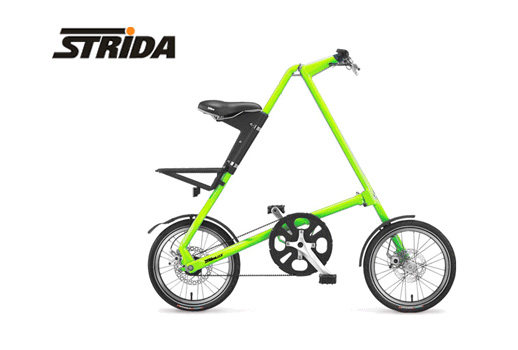
Weeks went by, and I saw a Strida for sale on craigslist. I got in touch with the seller, and she informed me that the bike had been won in a contest, and never ridden. We arranged for me to take a look at the bike, and after invoking the 24-hour rule (Sarah and I use a 24-hour rule to avoid impulse purchasing), I was the proud owner of the most glaringly fluorescent green Strida that’s ever been seen on Toronto streets. Even more proud because I had bought it with a 45% discount.
In riding trim:
And folded:
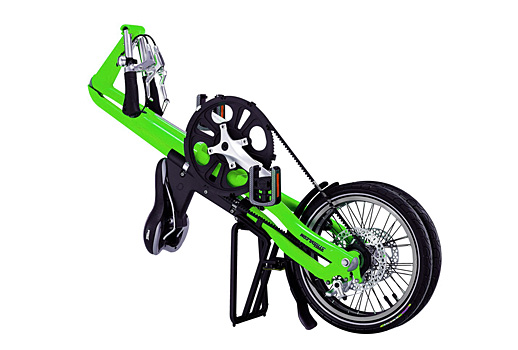
I’ve got about 150km on the bike since I bought it, and I am loving it. We used to have a really great bike storage option here at my office, but the new owner of the building has unfortunately removed it, meaning the only place to lock up our bikes is outside on the scarce bike racks outside the building. Several people have had bikes stolen from there, so I am reluctant to bring my Gary Fisher to work. I’d be traumatized to have that stolen. The Strida has been a perfect solution, since i can fold it up (in about 10 seconds!) and bring it up to my office. Back to commuting by bike, which is far more pleasant than the TTC.
I’ve never ridden a bike that made me smile so much while riding it, and even more so, never seen a bike garner so much attention from passersby. Children love it, and more than once have I heard a child exclaim “Hey Mister, I like your bike!”
I like my bike too.
Harrowed, redux Wednesday May 26, 2010, 0 comments
I’ve always prided myself on being what I’ve always called ‘responsible’. I try to live by my own personal manifesto. While it doesn’t specifically say anything about environmentalism, it does encourage minimalism in thought, deed and impact.
Now we have oceans burning, oil washing up on the shore, birds and fish dying by the metric ton. Sounds like end times to me. I am surprised it took this long for a major offshore drilling catastrophe. The problem isn’t that I don’t care. The problem is that I’ve been so harrowed, told so frequently that I am a bad person because of what I eat or wear, that I’ve become desensitized.
Hells bells people, I’m tired of being harrowed.
We don’t drive much, and when we do, it’s in a pretty efficient car. I cycle to work as often as I can. We walk to the grocery store. We actually chose to live in the city so we don’t have to rely on an automobile. We get bonus points for living in the city, because our carbon footprint is lower than that of people in the suburbs, apparently.
I don’t eat meat. I think that pate is a little bit cruel to the geese. We don’t have air conditioning in our house. We don’t own a gas-powered lawn mower. We don’t run our television all evening every evening, because we don’t have cable. On purpose. We care about these sorts of things.
I care about the environment. I care about the health of the world, and I care about ending war and famine. I don’t want the oceans to be depleted of fish.
I care about a lot of the same things that some of the most hardcore activists in the world care about. But I’m tired of being told I am a bad person, and that everything I do is bad. Because it’s simply not true.
I may not be creating as small an impact as some, but I don’t create nearly as much as others. My life choices are based upon the things I think are important. Being responsible is important to me. Responsibility in moderation. Because not everything is important.
If everything’s important, than nothing is. In the immortal words of Ford Prefect, ‘Sod the geese. You can’t care about every damned thing.’
Older posts